
⚠️ 18+ only. This page contains affiliate links — if you sign up through them, LuckyAviator may earn a commission at no cost to you.
Author: Victor Hale | Last updated: October 2026
Every Aviator “strategy” page you will find promises a way to beat the game. This one does not, because the game’s own formula makes that impossible: the expected result of any bet, at any cash-out target, is minus 3% of the stake. What a strategy can do is change the shape of your session — how often you win, how big the swings are, how long a losing streak you must survive. That is worth understanding, and it is what this page is about.
| The numbers every tactic must respect | |
|---|---|
| RTP | 97%, set by Spribe |
| House edge | 3% on every bet, at 1.2× and at 100× alike |
| Probability of reaching a multiplier m | 0.97 ÷ m |
| Rounds | Independent — the history ribbon predicts nothing |
| Crash point | Fixed by a hash before bets close (how it works) |
| What you control | Stake size and the moment you leave — nothing else |
The one formula behind every tactic
Under the standard reconstruction of Spribe’s crash formula, the chance that a round reaches a multiplier m is 0.97 divided by m. That single line decides everything:
| Auto cash-out target | Chance the round gets there | Net result per 100 bets of $1 (expected) |
|---|---|---|
| 1.20× | 80.8% | −$3 |
| 1.30× | 74.6% | −$3 |
| 1.50× | 64.7% | −$3 |
| 2.00× | 48.5% | −$3 |
| 3.00× | 32.3% | −$3 |
| 5.00× | 19.4% | −$3 |
| 10.0× | 9.7% | −$3 |
| 50.0× | 1.9% | −$3 |
Read the right-hand column again. The target changes how often you win and how much each win pays; it never changes the average. A 1.20× player wins four rounds out of five and loses slowly; a 10× player loses nine rounds out of ten and occasionally recovers in one hit. Over enough rounds both pay the same 3%.
Roughly one round in 25–33 ends at 1.00× — the plane leaves before any cash-out can fire. No target avoids those rounds, which is why “cash out at 1.01×” is not a free lunch: you win 1% ninety-six times and lose 100% four times.
Tactic 1 — Low auto cash-out (1.20×–1.60×)
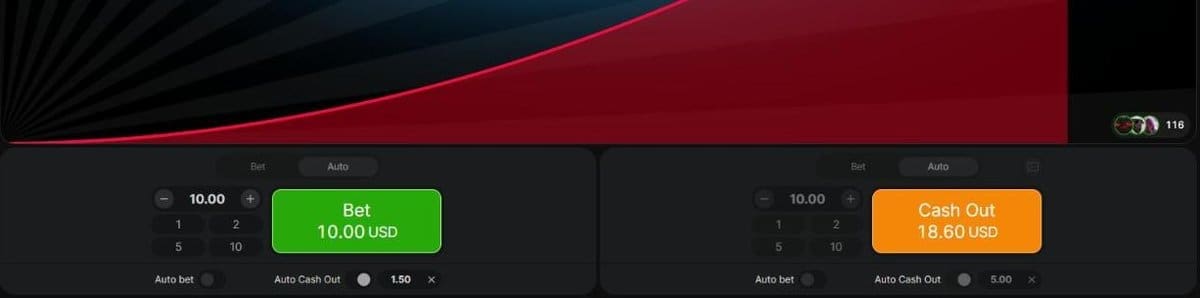
What it is. Set the target once, let the game cash out automatically, never touch it mid-round.
What it changes. Win rate goes to 60–80%, swings shrink, sessions feel calm. A $5 stake at 1.50× over four rounds typically looks like +2.50, +2.50, −5.00, +2.50 — small, frequent wins.
What it does not change. The 1.00× rounds and the 1.3× “almost there” rounds still take whole stakes. Over 100 rounds you expect to be down about 3% of total turnover, exactly as at any other target.
Who it suits. Players who want long sessions and hate variance. It is the tactic the demo is best at teaching, and the simulator on the demo page will show you its typical 100-round curve.
Tactic 2 — Two panels: anchor and runner
What it is. Panel A at a low target (1.30×–1.60×) with the larger share of the stake; panel B at a high target (3×–10×) with the smaller share.
What it changes. Texture. Most rounds the anchor pays and the runner burns; a few rounds per hundred the runner lands and makes the session memorable. Example: $4 at 1.50× returns $6 about two rounds in three; $1 at 5× returns $5 about one round in five.
What it does not change. Add the two expectations and you get −3% of $5, the same as one $5 bet. Both bets are on the same plane: a 1.02× round takes both.
Who it suits. Players who want a shot at a big multiplier without betting the whole stake on it.
Tactic 3 — Martingale (double after every loss)
What it is. Bet 1 unit at a target around 2×; after a loss, double; after a win, reset.
What it changes. Nothing good. It turns many small wins into one eventual large loss. At a 2× target you lose 51.5% of rounds. Seven losses in a row — which happens about once every 100 rounds — require a 128-unit bet to recover a 1-unit profit, and the table limit or your bankroll ends the sequence before the math does.
Why it fails mathematically. Each doubled bet still carries the same −3% expectation. Stacking negative-expectation bets does not produce a positive one; it produces a bigger negative one concentrated in rare rounds. The calculator below shows how many doublings your bankroll can afford and how often you will need more.
Who it suits. Nobody. It is the tactic that empties bankrolls fastest while feeling like it works.
Tactic 4 — Chasing high multipliers (10×+)
What it is. Small stakes at 10×, 20× or higher, waiting for the one round that pays.
What it changes. Variance goes to the maximum. At 10× you lose about 90 rounds in 100; at 50× about 98. A losing streak of 40 rounds at 10× is normal, not unlucky, so the stake must be tiny relative to bankroll.
What it does not change. Expectation is still −3%. The 97% of stakes you lose and the 10× you occasionally win net out to the same drift as the 1.20× player’s slow bleed.
Who it suits. Players who accept that the entertainment is the wait, size bets at well under 1% of bankroll and set a session stop.
The four tactics side by side
| Tactic | Win rate | Typical swing | Longest losing streak in 100 rounds (typical) | Expected result |
|---|---|---|---|---|
| Low auto cash-out 1.5× | ~65% | Small | 4–6 | −3% of turnover |
| Anchor + runner (1.5× / 5×) | ~65% on anchor, ~19% on runner | Medium | 4–6 anchor, 15–25 runner | −3% of turnover |
| Martingale at 2× | ~49% per round | Catastrophic when the streak comes | 6–8 (one of them wipes the series) | −3% of turnover, concentrated |
| Chasing 10×+ | ~10% | Very large | 30–50 | −3% of turnover |
Bankroll and session rules that actually matter
These do not beat the edge either. They decide whether a bad hour costs you a bad hour or a month’s budget.
- Stake 1–2% of the session bankroll per round. At 1.5× a 6-round losing streak is routine; at 2% per round that is a 12% dent, survivable. At 10% per round it is the end of the session.
- Set a stop-loss before the first round — a number, not a feeling. 30–40% of the session bankroll is common. When it hits, the session is over, including “one more to get back”.
- Set a stop-win too. Variance works both ways; the player who is up 50% and keeps going is handing it back at 3% per round of turnover.
- Use auto cash-out for the anchor bet. Reaction time is the one error the game lets you make; the auto setting removes it.
- Never raise stakes after losses. That is Martingale with a different name.
- Deposit limits in the casino account, set on day one. Every licensed operator offers them; the responsible gambling tools are listed on our disclaimer page.
Auto cash-out calculator
Enter a target, a stake and a bankroll. The calculator returns the chance a round reaches the target, the expected result per bet, the probability of k losses in a row and how many doublings a Martingale sequence could afford before the bankroll or a bet limit stops it.
Aviator auto cash-out calculator
Formulas: P(reach target) = 0.97 ÷ target (capped at 96% — about 4% of rounds end at 1.00× before any cash-out). Expected result = stake × (P × (target − 1) − (1 − P)) = −3% of the stake at every target. Streak probabilities use (1 − P)k; the “at least once” figures are approximations for independent rounds.
Predictors, signals and “hacks” are not strategies
A strategy is a rule you apply to numbers you can see. A predictor claims to know a number nobody can see — the next crash point, which is generated from a server seed and three client seeds that only exist once bets are placed. Every predictor app, Telegram signal and “hack” is therefore selling noise; the predictor page explains the mechanism and the signals page shows how the channels fake their results.
Practise first, then decide
Run any of the four tactics in the free demo for 100 rounds before you deposit. If a tactic feels unbearable with virtual credits — the Martingale streak, the 10× drought — it will feel worse with real money. The demo uses Spribe’s own build, so what you see is what you get.
Where to play Aviator for real money
Play in 1WINTop Crash Casinos 2026
| Casino | Welcome Offer | |
|---|---|---|
| VAVADA | 100 free spins no deposit + 100% up to $1,000 | Play Now |
| SpinBetter | 150 free spins no deposit — promo code FREESPINWIN | Play Now |
| 1xSlots | 150 free spins — promo code 150XSLOTS | Play Now |
| Slottica | 50 free spins no deposit | Play Now |
| Duel | 50% Rakeback — no wagering | Play Now |
| BitStarz | €500 / 5 BTC + 180 Free Spins | Play Now |
| Play Fortuna | 20 FS No Deposit (BONZA) + up to $500 & 90 FS | Play Now |
| Pin-Up | 120% + 250 Free Spins | Play Now |
Frequently asked questions about Aviator strategy
What is the best strategy for Aviator?
There is no strategy with a positive expectation; the house edge is 3% at every cash-out target. The “best” tactic is the one whose variance you can tolerate: low auto cash-out for calm sessions, anchor-and-runner for a mix, nothing that raises stakes after losses.
Is 1.5× a good auto cash-out?
It wins about 65% of rounds and keeps swings small, which makes it the most comfortable setting for most players. It still loses 3% of turnover in the long run.
Does the Martingale work in Aviator?
No. It converts frequent small wins into a rare large loss and runs into bet limits or your bankroll within a few hundred rounds. The calculator above shows the streak probabilities.
Can the history of past rounds help me?
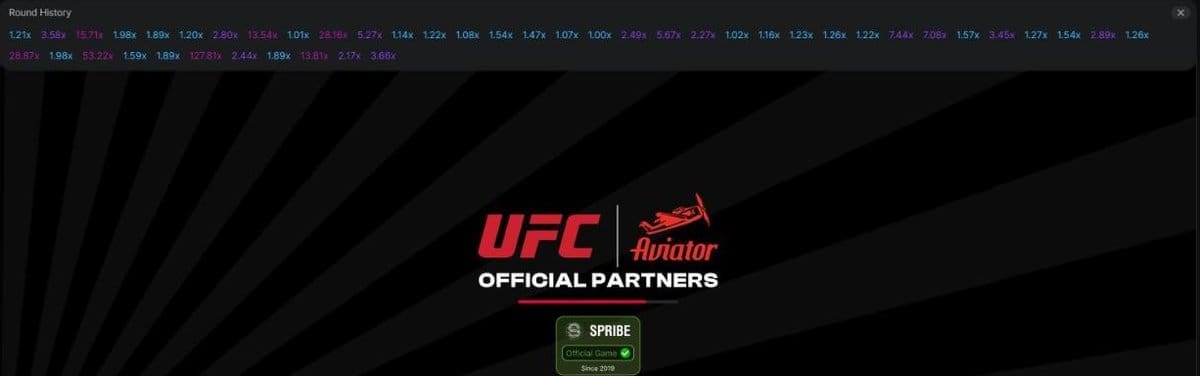
Only to confirm the game is behaving normally. Each crash point comes from a fresh hash; the previous ten rounds have no influence on the next one.
What is the safest bet size?
1–2% of the money you have set aside for the session. That survives the losing streaks that every target produces.
Does cashing out manually beat auto cash-out?
No. Manual cash-out adds reaction time, so you exit slightly later than intended or miss the exit entirely. Auto cash-out fires at exactly the target.
Are there Aviator strategies that work in the demo but not for real money?
The math is identical. The difference is psychological: losing virtual credits is painless, losing money is not, and that is when players abandon their rules.
Play responsibly. 18+. Gambling should be entertainment, not income. If it stops being fun, seek help at BeGambleAware.org or GamCare.
Sources and method
Probabilities and expectations are derived from the publicly reconstructed Spribe crash formula (RTP 0.97; multiplier = max(1.00, floor(0.97 ÷ (1 − h/2⁵²) × 100) ÷ 100)), verified against a published round on 3 October 2026 — see the provably fair walkthrough. Streak figures in the comparison table are typical values from 500-round simulations in our session simulator. Screenshots were taken by us in October 2026.